
Understanding Your Treatment Options for Big Toe Arthritis
Why Choosing the Right Procedure Matters for Pain, Motion, and Long-Term Foot Health
Osteoarthritis of the big toe — medically known as hallux rigidus — can cause pain, stiffness, and difficulty walking. When conservative treatments (like medications, injections, or shoe modifications) aren’t enough, surgery may be recommended to relieve pain and restore function. Two commonly discussed surgical options are hemiarthroplasty implants and fusion (arthrodesis). Understanding the risks and benefits of each can help you make an informed decision with your surgeon.
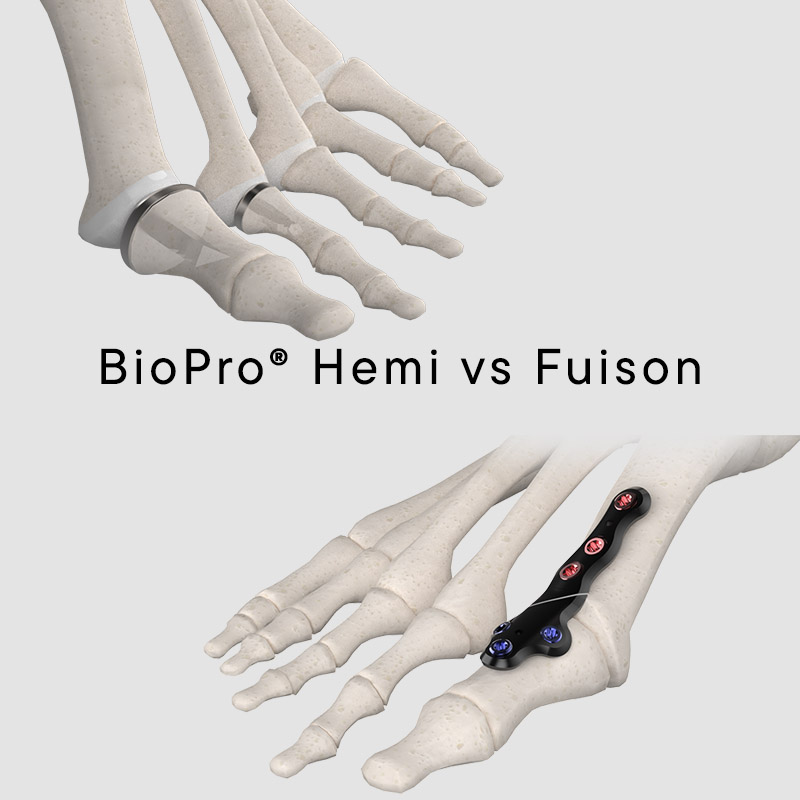
What Happens in These Procedures?
Hemiarthroplasty (Implant)
Hemiarthroplasty is a joint-preserving procedure that replaces only one surface of the joint — typically the base of the proximal phalanx — with a smooth metal implant like the BioPro Hemi Toe Implant.
Benefits seen in clinical studies include:
- Maintains natural toe motion and joint mechanics.
- Quicker recovery compared to fusion, with many patients weight-bearing soon after surgery.
- High patient satisfaction and pain relief documented in long-term follow-ups.
- Minimal bone removal helps keep future revision options open.
Fusion (Arthrodesis)
Fusion surgery involves permanently joining the two bones of the big toe with hardware (screws, plates), eliminating motion at the joint. It is considered the “gold standard” for severe hallux rigidus by many surgeons.
Fusion advantages include:
- High likelihood of eliminating pain from bone-on-bone contact.
- Very reliable long-term success for many patients when healing is complete.
Risks & Considerations: Hemi Implant vs Fusion
Risks of Hemiarthroplasty Implants
Even though joint implants like BioPro Hemi generally show excellent outcomes, like any surgery, there are potential risks:
- Loosening or migration: In some studies of joint arthroplasty (especially older designs), loosening or movement of the implant has been observed.
- Bone changes around implant: Radiolucency (bone changes on X-ray) and bony overgrowth may occur — though this doesn’t always impact pain or function.
- Revision surgery: A small percentage of patients may need further surgery; however, implants with minimal bone removal are often easier to revise than extensive bone procedures.
- Metal sensitivities: Some implant materials (like cobalt-chrome) contain nickel and may require alternative materials for patients with sensitivities.
Overall, studies comparing metallic hemiarthroplasty and fusion show similar complication and revision rates, and hemiarthroplasty can be favorable for patients who want to preserve motion.
Risks of Fusion Surgery
Fusion is very effective at relieving pain, but it also has unique drawbacks:
- Loss of joint motion – Because the joint is permanently fixed, you no longer bend the big toe during walking. This can slightly change how you walk and place pressure on other parts of the foot.
- Limited revision options – Once fused, there is no turning back. If pain or other issues develop later, revising or reversing the fusion is complex.
- Nonunion (failed fusion) – A known complication — meaning the bones don’t heal together as planned — occurs in a notable percentage of cases and may require additional surgery.
- Hardware irritation or infection – Like any surgery involving metal hardware, there is potential for irritation or infection.
- Rare serious complications – Extremely uncommon events like digital ischemia (blood flow problems) have been reported in isolated case reports.
- Altered gait is a concern for some patients after fusion, as the big toe no longer bends normally; studies suggest there can be biomechanical changes and compensation in walking patterns.
What Patients Are Saying
Real-life experiences shared by patients considering or undergoing fusion and implant procedures illustrate common concerns about mobility, gait changes, and revision challenges — with many seeking options that allow movement while reducing pain.
So, Which Option Is Right for You?
There is no universal answer — every patient’s goals, activity level, joint condition, and health history are unique. However:
✔️ If maintaining toe motion, quicker recovery, and future treatment flexibility are priorities, hemiarthroplasty implants like the BioPro Hemi may be an excellent option.
✔️ If pain elimination and long-term joint stability are your top goals — and loss of motion is acceptable — fusion remains a strong choice.
Work Closely with Your Surgeon
Discussing the pros and cons of each procedure — especially in the context of your lifestyle and goals — is essential. Ask your surgeon about:
- Expected recovery timeline
- How the procedure may affect your gait and daily activities
- Implant design and long-term data
- Revision strategies if needed
Final Thought
Both hemiarthroplasty implants and fusion can provide pain relief and improved quality of life for hallux rigidus. Understanding risks, functional outcomes, and what the data shows helps you be an informed patient and partner in your care.
Learn what treatments may be right for you.
Find a Surgeon
To locate experienced surgeons in your area, please complete the form to access our surgeon locator. Alternatively, you can email us at info@bioproimplants.com or call (810) 982-7777.
Consult with your surgeon
Discuss all your possible treatment options and expectations after surgery.
Undergoing joint replacement
Joint replacement surgery with the BioPro Hemi Toe is an outpatient procedure. You should be in and out in one day and on the road to recovery.